Proud member of the NVIDIA Inception program
Scene Intelligence for the physical world.
Qode Platforms converts real-world environments into named, versioned, queryable spatial graph assets (QSG), geometry-encoded, semantically indexed, and authorized for any system that needs to act in physical space. The Scene Intelligence stack ships today: QSE extracts the graph, QSG stores it, QSV renders it for human review, and QQP answers spatial questions without ever reconstructing raw geometry.
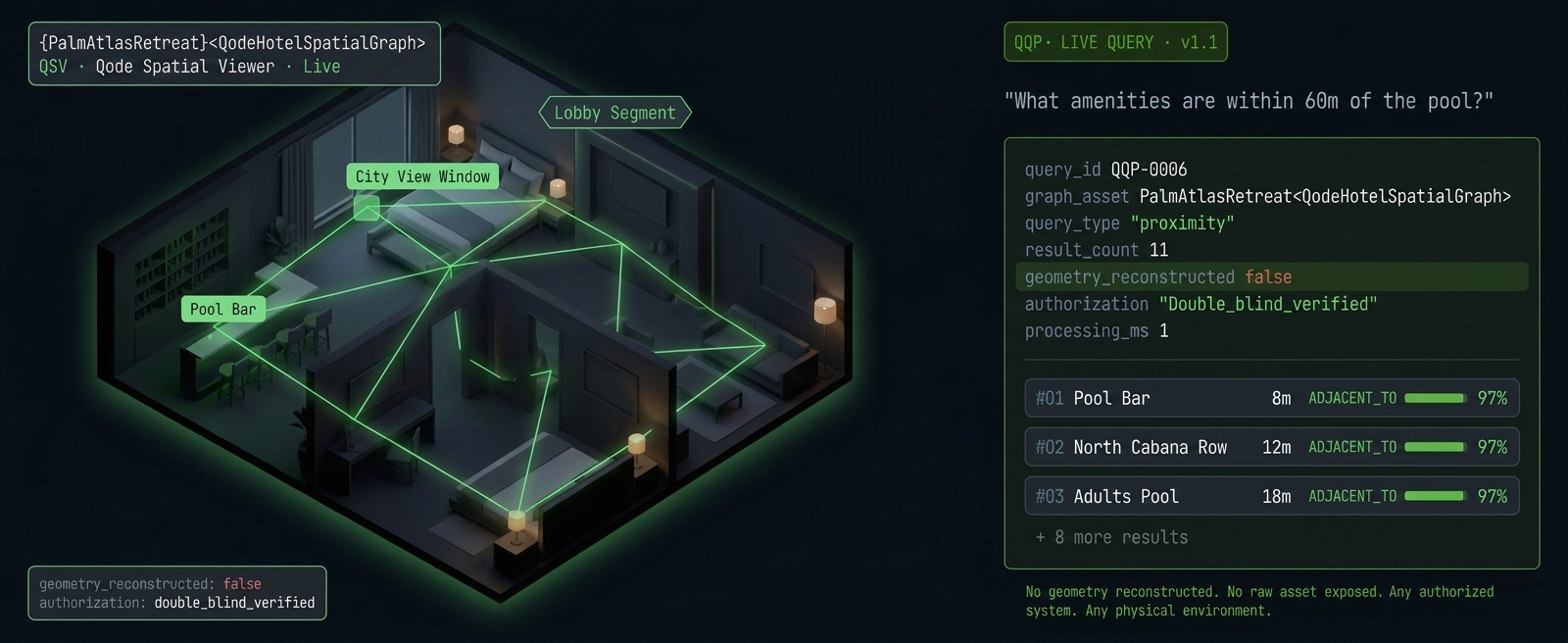
Reads any OpenUSD scene and produces a typed spatial graph asset and a compressed GLB file for rendering.
The versioned, sovereign repository where named spatial graph assets are stored, audited, and caller-authorized.
Streams the compressed scene to any authorized browser surface in under 30 seconds. The only surface where humans see the scene.
Answers spatial questions — proximity, routing, sightlines, egress — as structured data, without ever reconstructing raw geometry.
Two live demos. Five QSG assets in production. QSE · QSG · QSV · QQP shipping today.
The internet indexed text.
Qode Platforms indexes physical space.
The internet was built for text and 2D pixels. Search made documents queryable without re-reading every one. The physical world has never had its equivalent — until now.
Qode Platforms does the same for physical space — encoding Scenes once, answering spatial questions forever, without ever reconstructing raw geometry. The Scene is the asset. The graph is the index. QQP is the search layer.
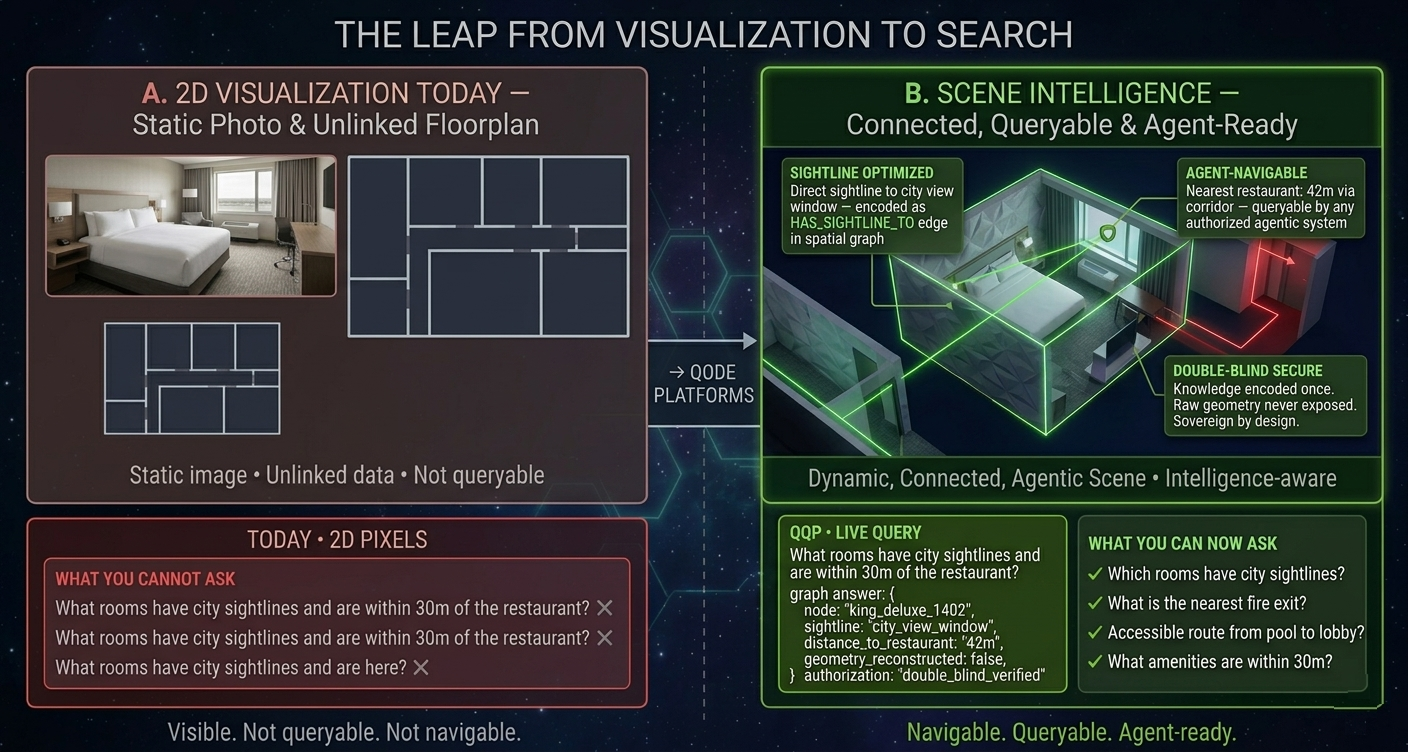
Qode Platforms builds the missing layer — a durable, secure spatial substrate that AI systems can reason over and act through without ever observing raw space. The Double-Blind protocol ensures every encoded Scene stays sovereign, compliant, and accessible only to authorized callers. Travel and Hospitality is the first domain. The stack serves any physical environment.
From physical world to Scene Intelligence.
Six stages. Two domains. NVIDIA converts the physical world into structured USD. Qode extracts, renders, and queries it as Scene Intelligence — without ever reconstructing raw geometry.
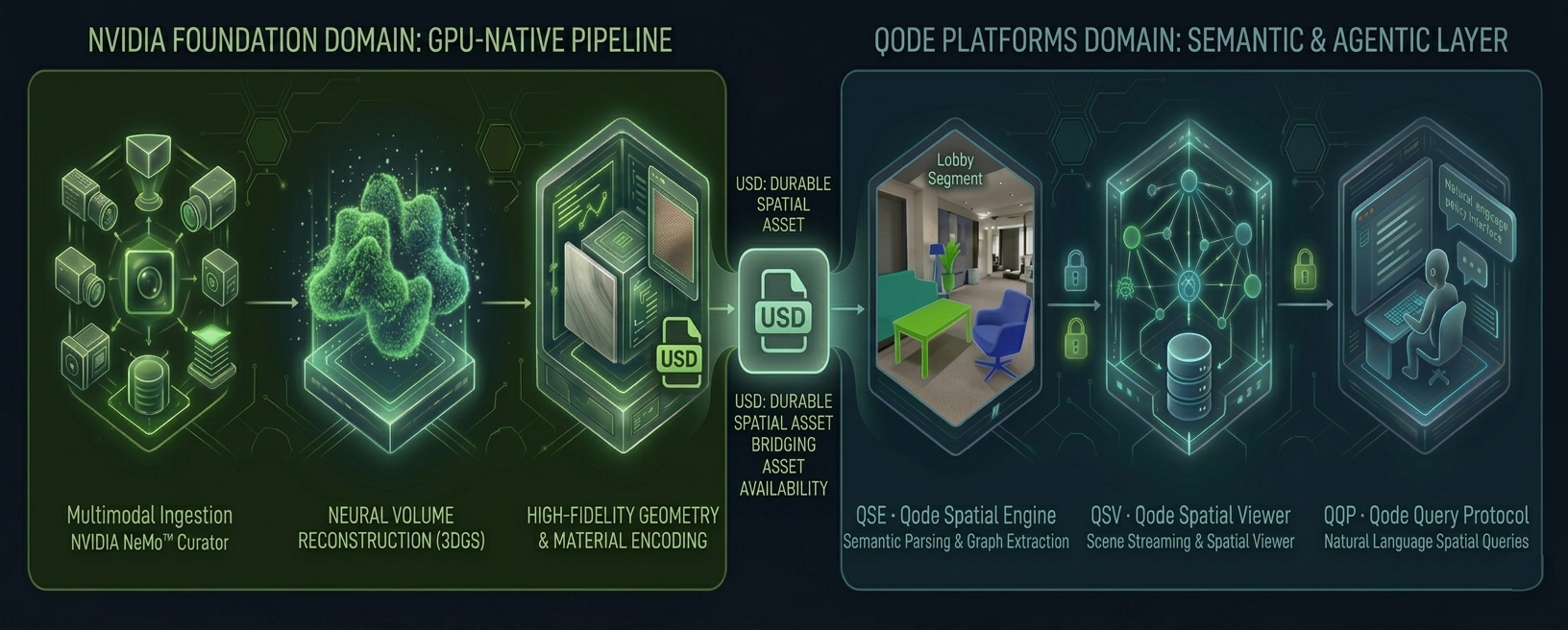
NVIDIA's GPU-native pipeline converts the physical world into a structured OpenUSD asset through multimodal ingestion, neural volume reconstruction, and high-fidelity geometry encoding.
Qode Platforms extracts, streams, and queries that asset as Scene Intelligence — delivering spatial answers to any authorized system without ever reconstructing raw geometry.
The architecture of Scene Intelligence.
Three architectural principles define how Qode Platforms encodes, secures, and governs physical space as a durable, queryable graph asset.
Queryable Scene Intelligence
Space is decomposed into a hierarchical graph of nodes and typed edges. Once encoded, subsequent queries through QQP do not require geometry reconstruction — spatial reasoning becomes a graph traversal problem, not a rendering task.
Double-Blind Spatial Safety
Autonomous agents operate as blind logical actors — they receive deterministic answers to spatial queries without ever accessing raw geometric data. Knowledge is decoupled from observation. The scene stays sovereign.
Human-Led Governance
A production-grade spatial graph must be self-healing and responsive to real-world changes. Human operators retain administrative sovereignty — scheduling state changes, resolving conflicts, and authorizing atomic graph updates.
Beyond 2D Pixels
The full architecture of queryable Scene Intelligence and Double-Blind spatial safety — including the Spatial Firewall, Human Super Actor governance model, and the roadmap toward verifiable spatial truth.
Products
The Scene Intelligence stack
Qode Platforms ships two products (engine and viewer), one repository hub, and one AI-powered query protocol for agents and systems. Together they form a complete scene intelligence stack, from USD conversion to versioned graph asset to human-authorized rendering to agentic query. Travel is the first domain. The stack serves any physical environment.
Converts USD into QSG.
The AI-powered pipeline that reads an OpenUSD scene and produces two outputs from the same source: a typed spatial graph (QSG) for intelligence and query, and a compressed GLB scene asset for human-authorized rendering via QSV. Nodes are spatial entities. Edges are typed relationships. Properties are vector-embedded semantic descriptors. Level 1 is live. Level 2 automates graph extraction end-to-end.
The versioned spatial graph asset.
The durable output of QSE — a named, versioned, sovereign graph asset. Like a Git repository for physical space: every state change is a commit, every release is tagged, every caller is authorized. The QSG is what Legal owns, Compliance audits, and agents query.
Human-authorized scene rendering.
The only surface where raw scene geometry is streamed — and only to authorized human reviewers. QSV is not an agent interface. It is the governance layer: the tool through which Human Super Actors review, validate, and authorize the encoded scene before it is committed to the QSG. Agents never see what humans see here.
Agents query space without observing it.
A structured AI query protocol that lets any authorized agentic system retrieve spatial intelligence — proximity, routing, sightlines, egress — from the QSG without reconstructing raw geometry. Every response is Double-Blind verified. Knowledge is decoupled from observation. Spatial reasoning as graph traversal, not rendering.
QSE Level 1 live. QSG, QSV, and QQP shipping. Five named QSG assets in production. Research and partner onboarding active.
Automated graph extraction pipeline. QSG Graph Hub — formal versioned registry with diff, changelog, and state commit. Scalable partner onboarding across Travel and Hospitality.
OccupancyData and FlowData layers added to the QSG — real-time occupancy per node, pedestrian flow rates per edge. QQP graduates from static spatial knowledge to dynamic operational intelligence: the same layout, but aware of current conditions. An agent routing a guest to the pool at 2pm gets a different answer than at 4pm when capacity is near. Management Console governs both layers under Human Super Actor authorization.
Ask a spatial question. The graph answers.
Raw geometry stays secure.
Select a pre-loaded query or type your own against {PalmAtlasRetreat}<QodeHotelSpatialGraph>. Matched nodes, typed relationships, distances, accessibility, and semantic tags come back as structured data through QQP. No 3D view rendered. No raw geometry exposed. Toggle the raw protocol response to see exactly what the API returns.
Qode Research Labs advances the protocols.
In 2023, while the world focused on AI that talks, Qode Research Labs began investigating AI that acts — specifically, the foundational gap between language models and the physical world they are increasingly expected to navigate. That investigation produced Qode Platforms.
QRL is not a founding story that ended. Every version increment of QSE, QSV, and QQP is a QRL output. The research is ongoing — and every QRL partner engagement advances the protocols on real-world physical environments.
Language is not enough.
Early research into agentic systems revealed a critical limitation: language-only AI, even when powered by the largest models, inherently hallucinates spatial relationships. In text, a probabilistic answer is tolerable — a human interprets and corrects. For an AI agent expected to navigate, book, or guide in a physical environment, a hallucinated floorplan or incorrectly perceived layout is a catastrophic failure. Travel required more than fluent text.
Physical AI requires spatial grounding — not probabilistic language.
Graph + 3D + semantics.
The research shifted focus toward physical AI models and spatial reasoning systems — architectures designed for hard safety constraints where actions must conform to the uncompromising laws of physics. This work defined the hybrid architecture that Qode Platforms is built on: graph-based logic for structured relationships, 3D context for accurate environmental awareness, and rich semantics for meaningful intelligence beyond simple pixels.
QSE → QSG → QQP is the production form of this architecture.
Knowledge decoupled from observation.
The most consequential research finding was architectural: an AI agent does not need to observe a space to know it. Encoding spatial knowledge once — into a typed, versioned graph — allows any authorized system to query it without ever reconstructing raw geometry. This decoupling of knowing from observing is the foundation of the Double-Blind protocol and the Human Super Actor governance model. It is what makes Qode enterprise-safe.
The scene is never exposed. The graph answers. A governance guarantee.
QRL research is formalized in versioned protocol releases. Each engagement with a real physical environment produces a new QSG asset, advances the QSE pipeline, and informs the next QQP protocol version. Results are published on qodeplatforms.com with partner consent.
QRL is not a consulting firm. It is the research engine that keeps Qode Platforms ahead of the protocols it ships.
The Qode Partner Network.
QPN is how physical environments join the Qode spatial intelligence stack. A structured three-party model — property, capture vendor, and Qode Platforms — converts any real-world environment into a named, queryable QSG asset. Travel and Hospitality is the first track. Ravi brings 25 years of domain depth from Sabre and Chase Travel to open doors that pure technology companies cannot.
Property Partner
The physical environment owner. Engages a USD capture vendor to produce the OpenUSD scene asset from their property. Signs the QPN partnership agreement. Receives a named QSG asset, QSV access for human review, and QQP for agentic query. Deploys Powered by Qode Platforms on their own surfaces.
USD Capture Vendor
The specialist that captures the physical property using multimodal inputs — video, HDR imagery, LiDAR, and floor plans — and runs the GPU-native reconstruction pipeline to produce a structured OpenUSD scene. NVIDIA Omniverse is the preferred authoring and validation environment. The resulting USD asset is delivered to Qode for QSE pipeline processing. Vendors may be recommended by Qode, sourced independently by the property, or identified through the NVIDIA ecosystem.
Qode Platforms
Runs the QSE pipeline on the delivered USD asset. Produces a named, versioned QSG asset. Activates QSV for human-authorized scene review and QQP for agentic spatial queries. Maintains the QSG registry, manages version commits, and ensures Double-Blind protocol compliance throughout.
Scene Intelligence experiences built on the QSG pipeline deploy on partner websites and surfaces — never on qodeplatforms.com directly. Every partner deployment carries the attribution:
Travel and Hospitality is not an arbitrary first choice. Ravi Erraguntla brings 25 years of enterprise travel experience — Sabre, Chase Travel, distribution systems, and supplier platform operations. Qode Platforms understands how physical travel inventory is sold, integrated, and where Scene Intelligence creates structural advantage at enterprise scale. That domain depth is the unfair advantage QPN partners get on day one.
Built by domain natives and spatial AI practitioners.
Qode Platforms is built around domain-native founder context, hands-on technical execution, and advisors who have navigated the NVIDIA ecosystem. Travel is the first domain. The team is assembling around the protocols — QSE, QSV, QQP — and the partner network that brings physical environments onto them.
Design the QSG schema, node and edge taxonomy, scene structure, and embedding logic that turns physical environments into machine-readable graph assets. Own QSE Level 2 implementation.
Develop the QQP orchestration layer — graph traversal, agentic query handling, retrieval reasoning, and protocol versioning across hotel, destination, and building use cases.
Translate QPN value into Travel and Hospitality adoption — aligning Scene Intelligence to property buyer workflows, QPN partnership agreements, and revenue impact at enterprise scale.
The internet was built for text. The next era needs systems that understand physical space. Qode Platforms is assembling the team to build that layer — starting with Travel, extending to every high-value physical environment where Scene Intelligence creates structural advantage.